
In the modern world, religious discrimination, sectarian conflicts, and radicalism are among the factors posing serious threats to international security. In many regions, from the Middle East to Europe, tensions on religious grounds are tearing societies apart and striking at the stability of states.
In such a complex geopolitical environment, Azerbaijan presents a different model—a policy of tolerance and multiculturalism. Its solid foundation rests on the consistent political priorities of President Ilham Aliyev, drawing strength from a history spanning millennia. During a meeting with religious leaders, the head of state declared that ensuring freedom of belief and state-religion relations in accordance with progressive historical traditions and international legal norms, as well as the promotion and encouragement of our national-spiritual values, is among the primary priorities of our state policy.
This policy is not merely a concept adopted at the state level, but an approach supported and implemented by various institutions of society. One of the entities playing a special role in this process is the Caucasus Muslims Board (CMB).
Azerbaijan's Tolerance Model
Azerbaijan has historically been a place where different religions and cultures converge. On these lands, Muslims, Christians, and Jews have lived together for centuries, forming an environment of mutual respect and trust. During the period of independence, this tradition became an important direction of state policy. The principles of tolerance and multiculturalism are accepted as one of the main pillars of the country's internal stability and social harmony.
In many Muslim countries, tensions exist between different sects, which sometimes lead to serious political and social confrontations. In Azerbaijan, however, a different model has formed. Believers belonging to different sects worship in the same mosques and perform religious ceremonies together.
The coordinating role of the Caucasus Muslims Board is significant in preserving this harmony. The entity promotes dialogue between religious communities, operates to prevent sectarian discrimination, and highlights the unifying essence of Islam.
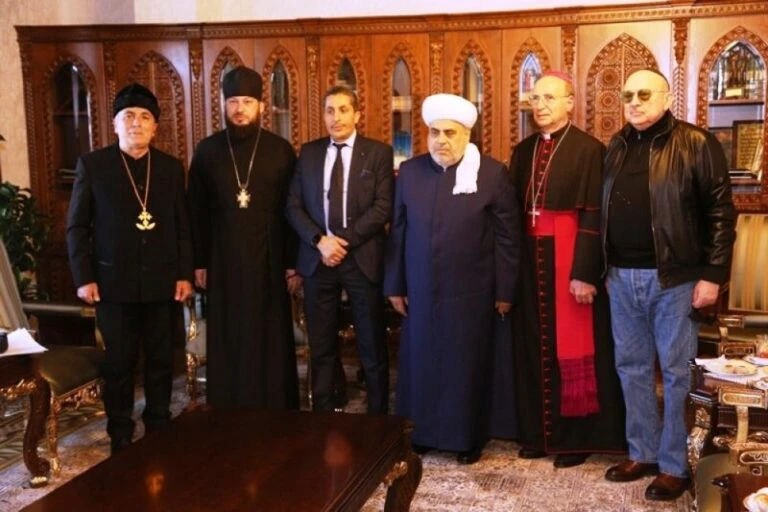
One of the key features of the Azerbaijani tolerance model is not only inter-sectarian but also inter-religious cooperation. In this direction, the CMB establishes close ties with various religious confessions and creates joint events and dialogue platforms. Relations with Orthodox, Catholic, and Jewish communities in the country are based on the principles of mutual respect and cooperation. This, in turn, serves to strengthen religious harmony in society.
Ideological Position Against Radicalism
On a global scale, religious radicalism and extremism are assessed as serious sources of danger. In this context, the CMB prioritizes the promotion of traditional Islamic values. An open and principled position against religious fanaticism and extremism stands out in the entity's activities. Through religious enlightenment events, sermons, and public speeches, messages of peace, tolerance, and mutual respect are delivered to society.
The CMB plays an active role not only within the country but also at the international level. Speaking at various international forums, the Sheikh-ul-Islam presents Azerbaijan's tolerance model and calls for the development of interreligious dialogue. His ties with the Vatican, Orthodox, and other religious centers also serve to expand interreligious cooperation. As a result of this activity, Azerbaijan is recognized in the international arena as a platform for interreligious dialogue.
Cooperation Between State and Religious Institutions
One of the important features of the Azerbaijani model is the alignment of state policy with the activities of religious institutions. Thanks to this cooperation, religious stability is preserved, an ideological struggle against radicalism is conducted, and the environment of mutual trust in society is strengthened. From this perspective, the activity of the CMB is not limited to the function of religious administration but also acts as one of the important pillars of Azerbaijan's tolerance model.
Interested forces occasionally conduct smear campaigns against the Sheikh-ul-Islam, who supports this policy. These forces, connected to the religious-ideological groups of various countries, demand that the Chairman of the CMB satisfy limited religious interests rather than acting for the sake of Azerbaijan.
It should be noted that the activities of religious leaders are not limited to the religious environment alone. Especially in geopolitically sensitive regions, their positions can clash with the interests of various ideological and political groups. In Azerbaijan, Allahshukur Pashazade occasionally faces various pressures and smear campaigns due to his position supporting the principles of tolerance and statehood. There are several main reasons for these threats.
The first reason is that Azerbaijan's religious model does not suit certain ideological groups. In Azerbaijan, religious life is regulated within the framework of the state's principle of secularism and national interests. In this model, religion does not become a tool for political struggle, and no place is given to radical ideologies.
However, some foreign religious-ideological centers try to export various political models of Islam, or sectarian and ideologically oriented approaches, to other countries. Allahshukur Pashazade and the CMB he leads, however, defend the national religious management model. This position contradicts the interests of some radical or ideological groups.
The second main reason is the prevention of sectarian confrontation. In a number of regions where Muslims live, this factor has become a tool of political influence. Various power centers try to expand their spheres of influence by using these differences. Azerbaijan, however, applies a different approach: here, sectarian difference is not accepted as a cause for the fragmentation of society, but as a natural element of religious diversity. The CMB's activity is specifically directed toward preventing this confrontation. This, in turn, weakens the plans of groups wishing to establish influence through sectarianism.
The CMB exhibits a sharp position against foreign religious influence attempts. The main principle in Azerbaijan's religious policy is for religious institutions to operate in accordance with national interests. From this perspective, Allahshukur Pashazade has repeatedly stated that religious activity should not become a means of political and geopolitical influence. It is precisely because of this position that some foreign religious centers and groups under their influence try to pressure the CMB leadership or damage its reputation on the information plane.
Allahshukur Pashazade has participated in international interreligious dialogue platforms for many years and established cooperation with various religious leaders. As a consistent promoter of President Ilham Aliyev's policy of tolerance, the leading line of the CMB Chairman has been to present Azerbaijan as an example of tolerance and multiculturalism on an international scale. This sometimes causes dissatisfaction among forces competing for ideological influence in the region.
In the modern era, political and ideological struggle is conducted not only on political platforms but also through media and social networks. From this perspective, smear campaigns against religious leaders are also sometimes used as elements of information warfare. The goal is to weaken the reputation of religious institutions, create distrust in society, and create fragmentation in the religious environment.
Overall, the main reason for the accusations and pressures voiced from time to time against Allahshukur Pashazade is that the CMB he leads supports the Azerbaijani state's policy of tolerance and religious stability. This position, on one hand, serves to preserve religious harmony in the country, and on the other hand, contradicts the interests of certain groups wishing to exert political and ideological influence through religious matters.
In conclusion, these pressures can be assessed not just as a campaign directed against a single religious leader, but in a broader sense, as a part of the ideological struggle against Azerbaijan's model of tolerance.