
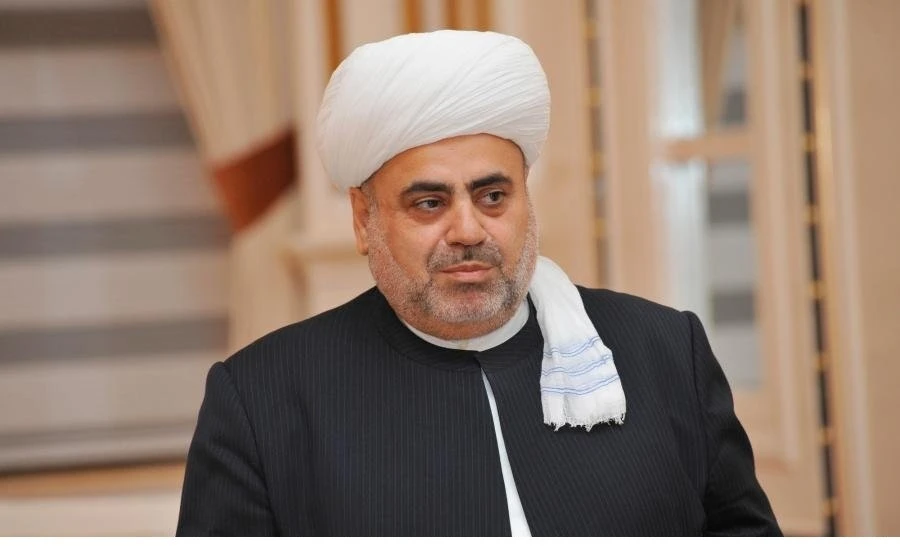
Great religious leadership means not only explaining the precepts of faith to people, but becoming the people's moral anchor in difficult moments, defending what is right, approaching the fate of the state with responsibility, and setting an example through one's own conduct. The public standing that Allahshukur Pashazade has built over many years cannot be imagined apart from precisely this sense of responsibility. Looking at the long life and work of Sheikh-ul-Islam Allahshukur Pashazade, this is the first thing one sees: responsibility before rank, the state before personal relationships, the whole of religion before any single denomination — and, above all of these, Azerbaijan.
Born in 1949 in the village of Jil in Lankaran, and having received his religious education at the "Mir Arab" madrasa in Bukhara and the Tashkent Islamic Institute, Allahshukur Pashazade chose the path of religion from a young age. He began his work at the Caucasus Muslims Board in 1975; in 1978 he became the akhund of the Tazapir Mosque and deputy chairman of the Board; and in 1980 he was elected Chairman of the Caucasus Muslims Board and received the rank of Sheikh-ul-Islam. Yet his path cannot be explained merely by this succession of posts. Over time he took shape as a religious leader, scholar, professor, public and political figure, an authoritative voice in relations between state and religion, and one of the faces of Azerbaijan in international interfaith dialogue.
For Allahshukur Pashazade, the state has never been merely a political institution. In his thinking, the state is the shield of the Homeland, the guarantee of the people's very existence, the greatest assurance for the survival of their religion, language, and spirituality. Perhaps for this reason he has never seen religion as a force standing against the state. He has striven to protect the sanctity of faith from the everyday passions of politics, and to keep a healthy relationship alive between the secular nature of the state and the religious and spiritual values of the people. For when the state grows weak, it is not only authority that weakens. The Homeland weakens. The mosque, the church, the synagogue, the school, the home — all are left exposed to danger. If the state exists, the call to prayer sounds in its own sky. If the state exists, a person lives out their faith without fear. If the state exists, followers of different religions can, under one flag, consider themselves the children of a single Homeland.
At the foundation of Allahshukur Pashazade's understanding of statehood lies precisely this truth. He did not turn his religious authority into a power that rivalled the authority of the state. He used his standing not to place himself above the state, but to stand alongside it. These are two very different things. One of the greatest tests of his statehood stance was 20 January 1990. In those days, when there were tanks on the streets of Baku, when the blood of peaceful people was being shed, when an empire raised arms against its own citizens, Allahshukur Pashazade spoke not only as Sheikh-ul-Islam but as a citizen of Azerbaijan. He protested. He appealed to the world. He held the leadership of the USSR to account for what had happened. He opposed any attempt to present the Azerbaijani people's will for freedom as religious fanaticism, as a Christian–Muslim confrontation, or as a supposed "threat of an Islamic state." In those days there were attempts to portray the events as a religious conflict and to dress the entry of Soviet troops into Baku in ideological clothing. Allahshukur Pashazade understood the true nature of this and stood against that intrigue. When it was reported that he had been offered the chance to take charge of governing the country, he did not accept it either. Because he saw far ahead. He knew that placing a religious figure at the head of political power could be used the next day to present Azerbaijan's national liberation struggle to the world in a different light. Instead of enlarging his own post, he chose to enlarge his state. Sometimes thinking big means being able to renounce the power you could hold. Sometimes statehood is not about attaining office, but about being able to decline it.
Later, at his meeting with Mikhail Gorbachev, he would refuse to shake his hand as a protest against the 20 January tragedy. Outwardly this may seem a small gesture. But sometimes a person's character is revealed precisely in such moments. To not lose one's dignity before rank and protocol, to not behave as though nothing had happened while the people's blood had been spilled — this too is a stance. In a personal matter one may choose not to hold a grudge. But before the blood of one's people, one cannot stay silent. To extend a hand is sometimes protocol. To withhold it is sometimes a stance before history.
After Azerbaijan restored its independence, Allahshukur Pashazade's responsibility grew even greater. A society emerging from Soviet atheism had gained religious freedom. But alongside this freedom, various foreign religious influences, radical currents, sectarian tendencies, and circles seeking to turn religion into a political force also appeared. At such a time, the task of a religious leader was not merely to open the doors of mosques. It was necessary to prevent new walls from arising in people's hearts. One of Allahshukur Pashazade's chief services is seen precisely here. He did not choose to govern the Azerbaijani Muslim by dividing them into Shia and Sunni. On the contrary, he saw Islam as a whole. For him, Azerbaijan is greater than any denomination. Religious affiliation is not a border that separates people from one another, but a matter of faith lived out within shared spiritual values. This is one of the clearest lines in the Sheikh-ul-Islam's religious activity.
Today, representatives of various denominations of Islam live in Azerbaijan. Yet denominational difference has not become a line of division in society. The Shia is not the enemy of the Sunni, and the Sunni is not the rival of the Shia. Within the same Homeland, the same flag, and the same faith in one God, different religious traditions live side by side. In some mosques Shia and Sunni pray side by side; representatives of different denominations are represented in religious structures; different religious traditions are brought together in the Council of Elders (Qazis) — this is no accidental picture. It is the result of a religious policy safeguarded over many years. In the Sheikh-ul-Islam's thinking, a denomination is not religion itself, but one of the roads leading to religion. The road may differ. The qibla is one.
The words in Imam Ali's (peace be upon him) famous counsel to Malik al-Ashtar — "People are of two kinds: either your brother in religion, or your equal in creation" — express well Allahshukur Pashazade's view of interfaith relations too. Within this single sentence lies a great philosophy of state and society. The one who belongs to the same religion as you is your brother. The one who does not is still a human being, your equal in creation. The essence of the Sheikh's relations with the Christian, Jewish, and other religious communities in Azerbaijan can be sought in this same thought. He has not seen Azerbaijan solely as the Homeland of Muslims. The one who prays in this land's church, the one who worships in its synagogue, and the one who prostrates in its mosque are all citizens of the Azerbaijani state. Their religions differ. But their Homeland is one. For this reason, his cooperation with different religious communities has not been merely protocol meetings. A greater idea stands behind it: to love the Homeland is a civic duty that rises above all religious differences.
The theme of Karabakh occupies a special place in Allahshukur Pashazade's work. The occupation of the lands, people driven from their native homes, tragedies such as Khojaly and Aghdaban — like every Azerbaijani, he too bears their heavy imprint on his life. At such a time, the language of hatred was the easiest path. But the responsibility of a religious leader is not to inflame anger further. It is to speak the truth without dragging the people into religious hatred. While defending Azerbaijan's rightful position on the Karabakh issue, Allahshukur Pashazade sought to prevent the conflict from turning into a Christian–Muslim war. He met with Armenian religious leaders. He spoke with the leaders of the Russian Orthodox Church. He built relations with Georgian religious leaders. He conveyed the truths of Azerbaijan to the world's religious centres.
The work Allahshukur Pashazade carried out during the years of independence was not confined to preserving religious stability within the country. In December 1991, his initiative and diplomatic activity played an important role in Azerbaijan's admission to the Organization of the Islamic Conference — today the Organization of Islamic Cooperation. Representing Azerbaijan at the Dakar summit, the Sheikh-ul-Islam met with the leaders of some twenty countries. In that period, Azerbaijan's recognition as an independent state by 47 Muslim states, and the raising of the Karabakh issue onto the international stage, were significant political developments.
Here, too, a characteristic is evident: the Sheikh-ul-Islam used his religious authority not to convert it into personal prestige, but to defend the interests of the state. In the world religious community, at the doors of the Vatican, on the religious platforms of Moscow, and in the influential centres of the Islamic world, he took part not merely as Allahshukur Pashazade, but as the religious leader of Azerbaijan. He carried Azerbaijan before himself. There are many religious leaders in the world. But not every religious leader's word carries equal weight in gatherings attended by heads of state, patriarchs, popes, sheikhs, and eminent scholars.
Allahshukur Pashazade's keeping of a certain distance from people is also a responsibility arising from the very nature of the post he holds. A religious leader cannot be equally close to everyone, present in every dispute, a participant in every personal relationship. The Sheikh-ul-Islam's personal conduct is often taken as the position of the institution he represents. For this reason, for one who holds high office, distance is not arrogance. It is responsibility. That over many years, passing through various political eras, he did not build his public position upon personal enmity, and strove to be just where he believed the truth lay, is among the important features of his character. He did not try to appear a friend to everyone, but neither did he build a relationship with anyone upon personal hostility. For high office should keep a person far from petty quarrels.
In Allahshukur Pashazade's religious and social views, the concepts of peace, mercy, justice, brotherhood, and hope have always been at the forefront. In his view, a person must never lose hope. Religion must call people not to confrontation, but to peace, mercy, and brotherhood. Islam is, in its very essence, a religion of security, brotherhood, and mutual aid.
He sees one of the main causes of religious confrontation in the use of religion as a tool for personal and political interests. The excessive politicization of religion first divides people into "us" and "them." Then it sets denominations against one another. Then it makes enemies of peoples. And in the end, human blood is shed in the name of God. Whereas religion should bridle the human ego (nafs). When the ego begins to govern religion itself, tragedy is born. Prophet Muhammad's (peace be upon him) regarding the one who controls his anger as the strong person is not only individual morality, but great social and political wisdom. To be strong is not to defeat another. It is to be able to defeat oneself — sometimes one's anger, sometimes one's ego, sometimes the lust for power, and sometimes the desire to overstep the limit even when one is in the right.
In Allahshukur Pashazade's work, an important place is held by the building of relations between state and religion on principles of cooperation and mutual respect rather than confrontation. We see that in various countries of the world there are serious contradictions, disagreements, and political confrontations between religion and the state. That such confrontation has not taken on a systemic character in Azerbaijan owes much, alongside state policy, to the responsible position of the religious leadership as well.
The Sheikh-ul-Islam's work should also be assessed in terms of building good relations between Muslims and the adherents of other religions, preserving religious stability, and strengthening the multicultural environment. For relations between state and religion to take shape on a healthy model, both the state's respect for religious communities and the religious leaders' respect for the constitutional order, the secular nature of the state, and nationwide interests are essential. Allahshukur Pashazade has served the preservation of this balance for many years. This balance did not arise by chance. That in Azerbaijan religion has not been turned into a political tool against the state, and that the state has not isolated religion from spiritual life, is the result of a culture of mutual responsibility formed over many years. The Sheikh-ul-Islam has always striven to safeguard this delicate line in these relations.
After Azerbaijan restored its independence, his activity took on a wider regional scale. As the Sheikh of all the Caucasus and Chairman of the Supreme Religious Council of the Caucasus Peoples, he contributed to strengthening Azerbaijan's standing among the peoples of the Caucasus and to preserving stability and mutual understanding in the region. He took a stand against forces seeking to create confrontation on religious and national grounds and to inflame relations between Muslims and non-Muslims.
His participation in international religious bodies is a continuation of this work. Along with being Chairman of the Caucasus Muslims Board, in various years he has served as co-chairman of the CIS Interreligious Council, chairman of the Consultative Council of Muslim Religious Leaders of the Commonwealth of Independent States, chairman of the Supreme Religious Council of the Caucasus Peoples, a member of the Aal al-Bayt Royal Islamic Academy of Jordan, a member of the Presidium of the Taqrib Committee for the rapprochement of Islamic schools of thought, and a figure represented in international interfaith dialogue institutions. Behind these posts stands a single line: to create, between religions and peoples, an environment of dialogue and understanding rather than confrontation. The international religious forums held on his initiative and with his participation in Baku, Moscow, Tbilisi, and other cities are also the result of that thinking. The World Summits of Religious Leaders, interfaith cooperation conferences, and peace forums have made it possible to present Azerbaijan's model of religious tolerance and multiculturalism at the international level. Earning respect among the world's religious leaders is not possible simply by being the head of one religious community. For this, one must be able to listen to different faiths, defend one's own position with dignity, and safeguard in every meeting the prestige of the state one represents. This is one of the foundations of the weight Allahshukur Pashazade has earned in the international community.
As a scholar and professor, Allahshukur Pashazade has held it important that religious activity not be limited to preaching alone. He has written scholarly works on Islamic history, Quranic studies, national relations, and religion. In 1992 he received the degree of Doctor of Historical Sciences, and since 1999 he has worked as a professor at Baku State University. On his initiative, various structures have been established in the field of religious education and scholarly religious research. The creation in 1997 of the Scientific Religious Council under the Caucasus Muslims Board was among the steps serving to present religion together with enlightenment, learning, and sound reasoning.
Looking at the course of Allahshukur Pashazade's life, the most important question about him is this: at the fateful moments, where did he stand? On 20 January, he stood with his people. During the years of independence, he did not set religion against the state. On the Karabakh issue, he defended what was right, yet did not open the way to religious hatred. Among denominations, he gave preference to unity rather than division. In relations with different religious communities, he took the principle of Homeland and citizenship as his foundation. In his relations with the world's religious leaders, he represented Azerbaijan before himself. He did not turn personal relationships into affairs of state. He did not stay silent where he believed the truth lay. For him, Azerbaijan is greater than denominations, than personal relationships, and than passing political interests. The existence of the state, the unity of the people, religious stability, and the prestige of the Homeland are supreme values for which a religious leader too must bear responsibility.
At the end of a human life, offices one day become lines in the pages of history books. Chairman, Sheikh-ul-Islam, professor, scholar, member of international organizations — these are all titles written before a name. What matters is the meaning the name itself carries. The meaning of the path Allahshukur Pashazade has travelled lies not in religious leadership alone. This path is seen in placing the existence of one's state above one's personal rank; in standing with one's people on the hardest day; in protecting the sanctity of faith from political passions; and in building not walls that separate Shia from Sunni or Muslim from Christian, but bridges that unite them in a Homeland called Azerbaijan.
Looking at the course of Sheikh-ul-Islam Allahshukur Pashazade's life by these measures, one truth becomes clear: if the state is held above all else, then the person who serves it must also be able to stand above his own personal claims.
Perhaps this is what true strength is.
Perhaps true dignity, too.
Perhaps true statehood, too.
Today the Sheikh of all the Caucasus turns 77. On this occasion, we wish His Eminence the Sheikh-ul-Islam robust health, a long and healthy life, and success in his responsible and honourable work. May his activity — ever in the service of the state, the people, and interfaith and inter-denominational solidarity — continue successfully hereafter, and may the good works he has done and will do always be met with respect and esteem.
Source: 525.az